The World's First Tolf Course
A New Game Born on a Piece of Property You Can Actually Buy
Every game we love today started as someone's backyard experiment. Golf began as Scottish shepherds knocking pebbles into rabbit holes with bent sticks. Basketball started with a peach basket nailed to a gymnasium balcony. Even Frisbee golf — one of the fastest-growing sports in North America — was dreamed up by a handful of Californians messing around with a plastic disc. Somewhere along the way, an ordinary patch of land becomes the proving ground for something entirely new. That's exactly what happened here.
How Games Get Invented
Most sports don't arrive fully formed. They're mashups — someone takes the rules of one game and the equipment of another and asks, "what if?" Golf is the clearest example: by the 15th century, Scots were playing a stick-and-hole game so popular it was actually banned in 1457 because it was distracting young men from archery practice. The ban didn't stick. By 1502, King James IV of Scotland had taken up the game himself, and royal approval sent it spreading across Europe. The hole — the idea of a target you had to aim for and sink something into — was the innovation that separated golf from every stick-and-ball game that came before it.
Disc golf followed a similar arc, just four and a half centuries later. In the 1960s, a Wham-O employee named "Steady" Ed Headrick redesigned the Frisbee into the aerodynamically stable disc we know today, patenting it in 1966. But Headrick didn't stop at the toy. He saw people flinging discs at trees and lamp posts for fun and realized the game golf had already perfected — get an object into a target, in as few throws as possible — could work just as well with a flying disc as with a ball and a club. In 1976 he invented the Disc Pole Hole, the chain-and-basket target still used on disc golf courses today, and founded the Professional Disc Golf Association to formalize the sport. What had been an idle pastime in a few California parks became an organized game played on thousands of courses worldwide.
The pattern is the same every time: take a familiar target-and-scoring structure, swap in a different piece of equipment, and see what happens when people actually try it on real ground.
INTRODUCING TOLF
Which brings us to this property — and to Tolf.
Tolf is exactly what it sounds like: tennis meets golf. Instead of clubs, players use modified tennis rackets and scoop-style paddles to launch tennis balls toward a series of holes scattered across the grounds. The scoring works like golf — fewest strokes wins — but the swing, the grip, and the touch required are pure tennis. A driver here isn't a titanium club, it's a long-handled scoop built for distance. The putter is a modified racket, built for touch around the hole. And like any good golf course, there's real strategy: a fenced garden and a stray shot through the greenhouse both carry a one-stroke penalty, so restraint matters as much as power.
Cal Condy and his wife Sun moved from Kelowna to Cortes Island in 2019. Cal invented the game and designed the course shortly after purchasing the property. When he built this course he understood the same thing every new sport figures out — that the fun isn't in reinventing everything, it's in reinventing just enough. Keep golf's scoring and its sense of a journey from hole to hole. Swap in tennis's equipment and technique. Add a splash of personality — hand-painted signage, a suggested green fee, an honour-system donation box — and you've got a game people want to play again and again.
Cal says, "The game was invented as my 1st idea was to build a par 3 course, but, due to the amount of windows on site, I didn’t think golf balls flying around would be such a great idea. I neede something softer. A tennis ball would work. But you can’t really hit a tennis ball with a golf ball….ok…tennis ball…tennis racket! Cool. That was the 1st version, and it was pretty good. I got some score cards printed up. The name “Tolf” was a natural fit. A year or 2 later, the dog “ball chucker” was added as a driver, to give extra distance."
A Course Woven Through Heritage Landscaping
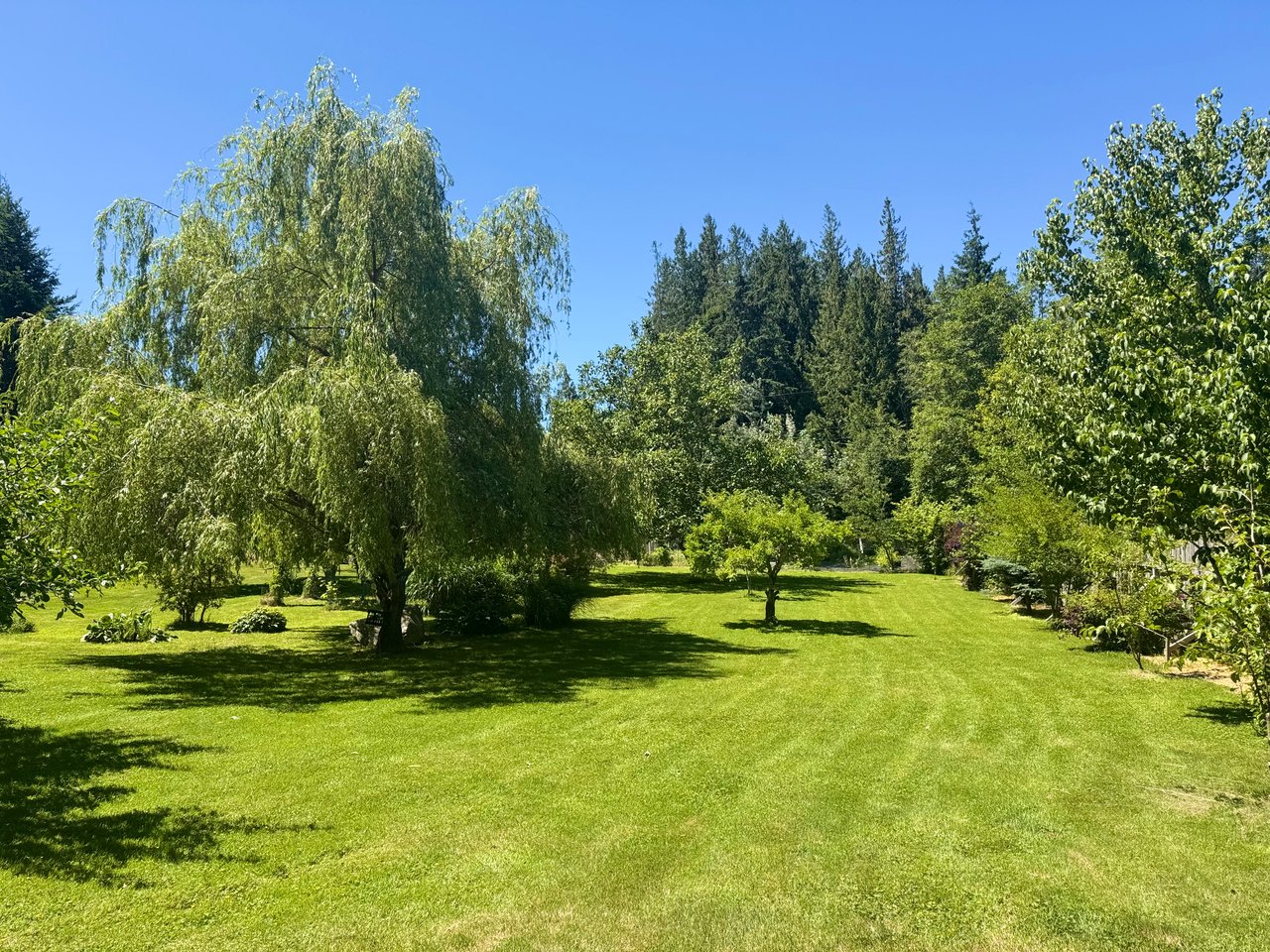
What makes this particular Tolf course remarkable isn't just the game itself — it's the ground it's played on. The eighteen holes wind through the property's exceptional heritage landscaping, mature plantings and established garden rooms that took decades to grow into their current form. Players tee off past century-old trees, thread shots along stone paths, and navigate around a working greenhouse that doubles as both hazard and landmark — the sixth hole sits directly behind it, and a wayward shot through the glass costs you a stroke, the same way water costs you a stroke on any traditional golf course.
The eighteenth hole finishes near the garage, where the course designer notes a high, lofted shot is the smart play and advises staying right of the marker — the kind of local knowledge that separates a first-timer's card from a low one. It's a small detail, but it's the same kind of detail that gives a real golf course its character: quirks born from the land itself rather than imposed on it.
That's the part that can't be manufactured. You can build a Tolf course on any flat lawn, but you can't fake decades of heritage landscaping — the layered gardens, the established canopy, the sense that the land has a history the game now gets to run through. This course exists because the property already had the bones of something special, and someone had the imagination to see a game hiding inside it.
Be a part of Game Invention History
Golf took root in Scotland and conquered the world. Disc golf grew out of a few tossed Frisbees in a California park. Every sport now taken for granted was, at some point, just an idea someone tried out on a specific piece of land.
AND- if you are interested, let your Realtor know and when you tour the property you might even be able to play a round of TOLF with Cal!
Interested in this unique property? Visit the custom property website by clicking this link: or view the property video on YOUTUBE https://youtu.be/sKCpep86klk
Article by Jeramie Ellingsen
www.jellingsen.com 250.203.5145 [email protected]