Where the Strait Narrows: Whales at the Gateway to Desolation Sound
A Sense of Place 1704 Tiber Bay Rd., Cortes Island, BC
The Discovery Islands and Desolation Sound sit within the traditional, ancestral, and unceded territory of the Tla’amin, Klahoose, and Homalco Nations — three closely related peoples who share the Ayajuthem language ʔayʔaǯuθəm (pronounced Ay-uh-joo-thum). Tla’amin territory runs from the Sunshine Coast north to Lund, BC through the Malaspina Peninsula and Texada Island; Klahoose territory extends from Cortes Island to Toba Inlet, taking in much of Desolation Sound itself.
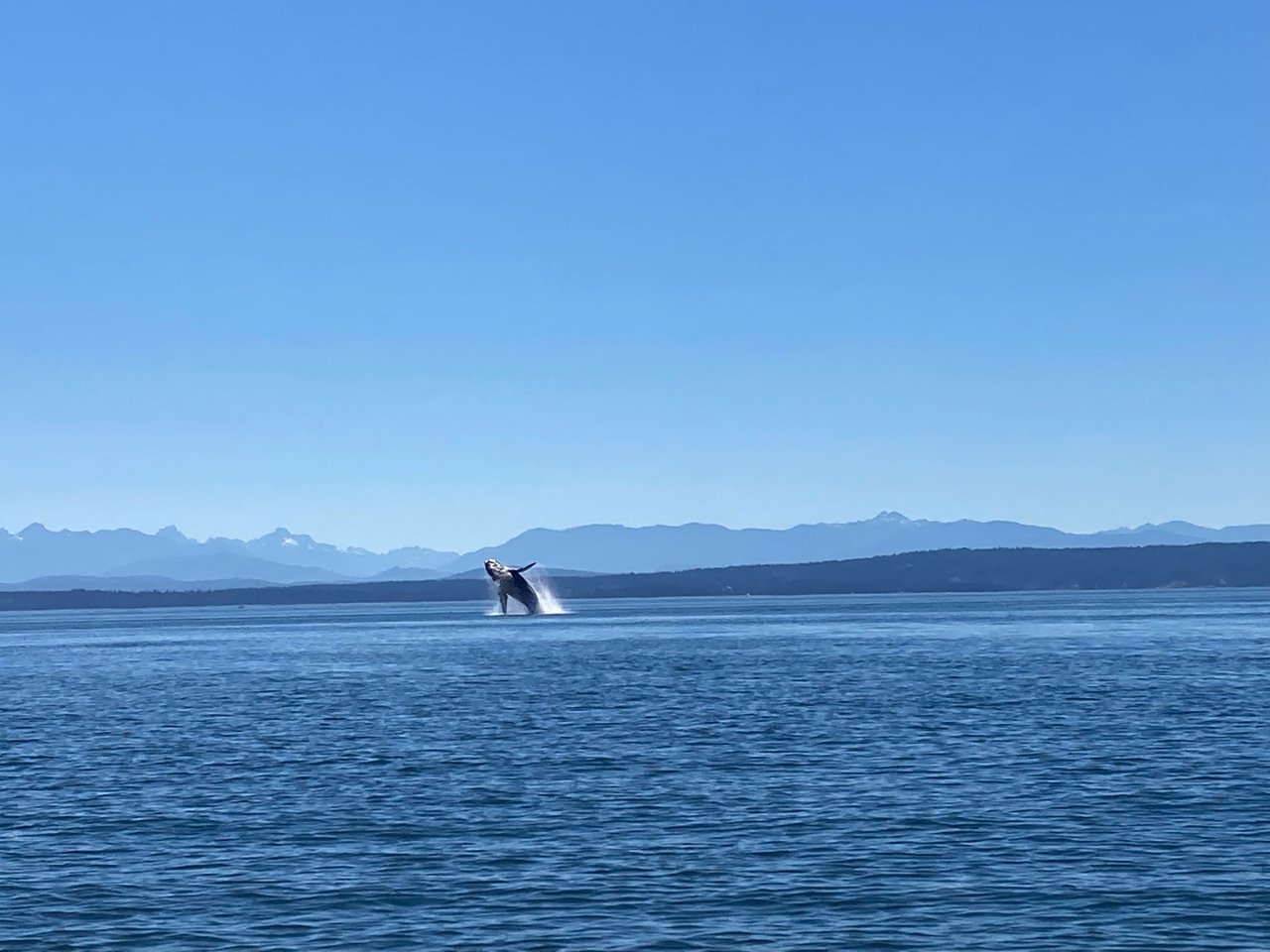
The geography on the Eastern Side of Cortes Island, BC acts as a funnel, concentrating wildlife as the waters flow towards the entrance to Desolation Sound. Warm surface water, steep-sided fjords bringing ice melt into the sea, and an unusually rich nutrient mix attract whales, Pacific white-sided dolphins, harbour seals, and sea lions.
Humpback whales, fished nearly to extinction along the coast a century ago, have been returning to these waters in growing numbers for more than a decade. They arrive seasonally, with sightings building through June and peaking in late summer. They are drawn by krill and herring that have been pushed into the strait by currents and upwelling. Boaters regularly report humpbacks surfacing mid-channel and lunge-feeding, sometimes close enough to shore to be watched from a deck chair.
Living With Whales: An Owner’s Perspective
Deepa and John, who first purchased land in Everwoods in the early 2000s, have spent their summers living on the bluff at 1704 Tiber Bay. Deepa describes this unique experience-
“Imagine our surprise when one night we woke up, around 2:30, to the sounds of whale breathing and beckoning us — we rushed out to see two grays rising gently and rolling gently back into the water with joyous sighs and grunts. When we built the house we were not focused on whales, but now they are the magic that keeps us on the wild Desolation Sound side of Cortes. And still just a quick drive out to the grocery store. Over the years orcas have come breaching to thrill visitors to our home and the wonder of the night calls has never ceased to amaze me. When one of us [in the community] spots a whale we alert our Cetacean WhatsApp Group.”
A Refuge
There’s a growing argument in residential design that a building’s real client isn’t the homeowner, the developer, or the architect — it’s the nervous system of whoever lives there. Architect and wellness-design founder Tamar Gail, who writes on what she calls Wellness Architecture, argues that every space either adds to stress or supports recovery, whether or not its occupants consciously notice. Her framework names nine recurring elements of restorative design: nature, light, thermal experience, water, movement, atmosphere, refuge, ritual, and connection.
1704 Tiber Bay Road wasn’t designed with Gail’s framework in mind — it predates her concepts entirely — but it aligns with nearly all of it anyway. Nature is not a sidenote or luxury feature; it is the contextual fabric of the entire experience. Light is reflected in the ocean each morning and evening. The cyclical nature of the tides invites you into the moon’s natural cycle. Thermal experience shows up in the wood-burning stove on a windy night, under your feet in the warmed floors, and again in the hexagonal hot tub nestled into the deck. The separate water-view studio and the arts building, set apart from the main house, function as exactly the kind of refuge Gail describes: distinct spaces for retreat, focus, or quiet that don’t compete with the rhythms of daily living. And the property’s rituals are available at every turn — a deck made for morning coffee facing the sunrise, a late-night jump into the ocean from the aluminum swim ladder.
Built in 2009 in a West Coast architectural style, the property includes a 2,225-square-foot main home with tiered decks, a separate 448-square-foot water-view studio with its own kitchen sink and sleeping accommodation, and a 915-square-foot arts building with a dance studio, sleeping loft, and pottery space. All three structures were built by local craftspeople using timber harvested on the property or salvaged from the shore.
In the early 2000s, a small group of investors bought the 150 acre Everwoods lot when it was slated to be sold to a Timber Company. Instead of cutting, the group placed roughly 80 to 90 percent of the parcel under a conservation covenant with The Land Conservancy of BC. The model became a case study in sustainable coastal community development. Rather than purchasing the parcel and buildings outright, ownership in Everwoods works through a share structure: a block of shares in Eco Initiatives Inc. gives the holder exclusive, perpetual use of one homesite, while the remaining 150 acres of standing forest — including old growth — is held and managed collectively.
In practice, this arrangement does real work for an owner, provided you’re a cash buyer; a share sale doesn’t qualify for traditional mortgage financing. The land itself can’t be subdivided, and the conservation covenant caps timber harvesting at roughly one tree in a hundred annually — protections that lock in the coastal rainforest setting a buyer is paying for, in a way that fee-simple title purchased elsewhere on the coast cannot guarantee. Annual carrying costs are modest and transparent: personal building taxes, a one-fifteenth share of land tax and infrastructure upkeep, and a modest community fee. For a buyer drawn to this area for its ability to provide a wilderness refuge from the modern day storm, the coop structure is less a complication than the mechanism that enables this unique property to exist inside such an enchanted setting.
Prospective Clients/Agents: For further information about 1704 Tiber Bay, visit the custom website and contact the listing agent, Jeramie Ellingsen. Jeramie specializes in representing unique coastal properties to discerning clients in the Salish Sea. www.jellingsen.com
A note on viewing marine life: boaters are asked to keep at least 100 metres from whales and dolphins, and at least 200 metres from any orca — closer if they’re resting or travelling with a calf. Please reference https://www.bewhalewise.org/ to learn more.
Sources:
More information on Indigenous Place Names and language can be found at: https://qathetmuseum.ca/place-names/ ; www.firstvoices.org
Tamar Gail, “The Nervous System Should Be the New Client,” LinkedIn, June 2026.
Wikipedia, “Malaspina Strait,” citing Walbran, British Columbia Coast Names, 1909; Ling & Dale, “Trust for Sustainable Forestry: Cortes Island,” CRC Research, Royal Roads University, 2008.